OneScan · Standard Edition

See every step before
the patient even
knows it's wrong.

A clinical-grade pressure-plate platform with a 2,304-point piezoresistive sensor array. Quantify asymmetry, track recovery, and prescribe with evidence — in one walk across the mat.

ONESCAN
2,304 sensor points
100Hz sample rate
8mm cell pitch
2,304pts
Sensor Array
100Hz
Pressure Sampling
560×490 mm
Active Surface
2.25/cm²
Sensor Density
01 / SYSTEM ARCHITECTURE

One instrument, built around the foot.

Pressure tells you what the foot is doing — every contact, every transfer of weight. The OneScan plate measures it densely, continuously, and clinically — across the entire gait cycle.
THE PLATE

OneScan Pressure Plate

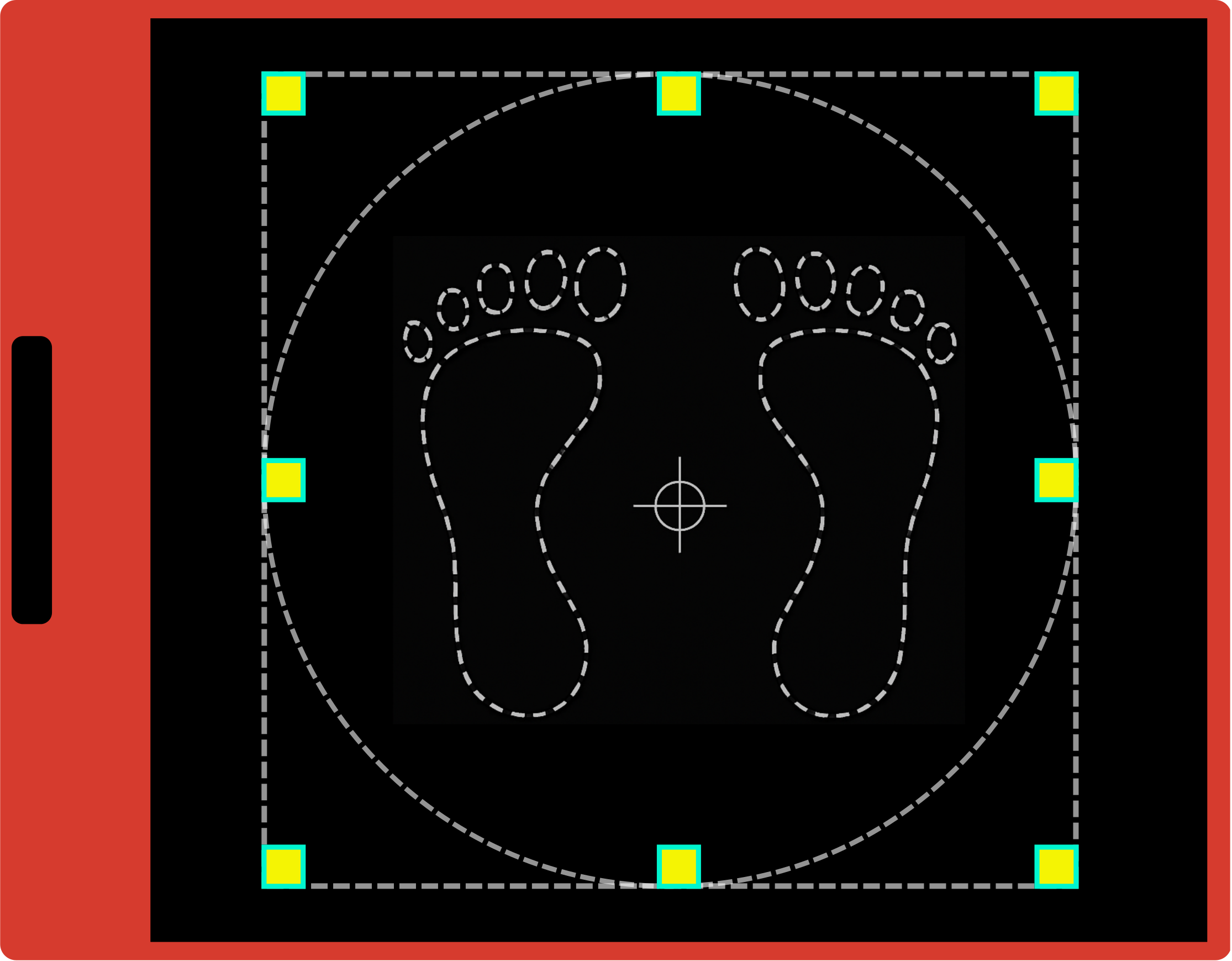
A piezoresistive grid array — 2,304 sensing points across 560 × 490 mm — captures plantar pressure, center-of-pressure trajectory, impulse, and step geometry at up to 100 Hz.

560 × 490 × 24 MM
2,304
Sensor points
100 Hz
Sampling rate
Piezoresistive
Grid array
≥ 8×8 mm
Cell pitch
02 / CAPABILITIES

From a single walk, a complete biomechanical record.

01

Quantitative assessment, not eyeball estimates.

Replace subjective therapist scoring with millisecond-precision pressure data. Every step, every contact, every Newton — captured, indexed, and comparable across sessions.

100 Hz pressure 2,304 sensors
02

High-density pressure grid.

A piezoresistive sensor matrix delivers 2.25 contacts/cm² across the entire mat — fine enough to resolve great-toe loading that other plates blur into the forefoot.

2.25 contacts/cm² ≥ 8 mm pitch
03

Center-of-pressure trajectories.

The "S-curve" of weight transfer through each foot, sampled continuously — revealing foot-drop, inversion, and avoidance patterns invisible to the eye.

Bilateral CoP
04

Heatmap signatures.

Static and dynamic pressure maps with clinical thresholds — flag lateral overloads, absent heel strike, and elevated forefoot impulse automatically.

Static · ≈ 20 s Dynamic · live
03 / CLINICAL APPLICATION

Hemiplegic gait, before and after.

Post-stroke patients lean toward the affected side, drag the paretic limb, or compensate with a circumduction pattern. The result is asymmetric, inefficient, and exhausting — and notoriously hard to score by eye.

Indication

Stroke · TBI · Cerebral palsy

Single-sided weakness or paralysis affecting the lower limb. OneScan quantifies the asymmetry, the load redistribution, and the recovery trajectory — across the three diagnostic axes that matter clinically.

⊕ Asymmetry · Step Length
Pre-rehab SI 40%
— after intervention →
Target SI 15%
⊕ Stability · Gait Speed
Pre-rehab 0.4m/s
— after intervention →
Target 0.8m/s
⊕ Biomechanics · Stance Time
Affected limb 55%
— after intervention →
Affected limb 60%

"Gait speed is the single best summary metric of recovery — every gain in strength, balance and coordination ultimately resolves into how fast the patient can walk to the bus stop."

04 / WHAT WE MEASURE

A vocabulary of eight clinical parameters, exported to your report.

P/01
Step Length
Bilateral, in millimetres. Symmetry index (SI) auto-computed; affected-side shortening flagged.
Asymmetry
P/02
Stance Phase Time
Percentage of cycle each foot bears weight. Reveals load avoidance on the affected limb.
Asymmetry
P/03
Step Width
Lateral distance between footfalls — wider base of support indicates compensatory strategy for poor trunk control.
Stability
P/04
Gait Speed
The gold-standard composite metric. Predicts community ambulation, fall risk, and recovery trajectory.
Stability
P/05
Center of Pressure Trajectory
The "S-curve" of weight transfer through the foot. Inverted or truncated paths reveal foot-drop or inversion deformity.
Biomechanics
P/06
Pressure-Time Integral
Impulse delivered through heel and forefoot — flags compensatory overload on the unaffected side.
Biomechanics
P/07
Maximum Pressure Distribution
Heatmap signatures: lateral high-pressure band (inversion), absent heel zone (avoidance), elevated forefoot (foot-drop).
Biomechanics
P/08
Cadence
Steps per minute. Read alongside step length to interpret whether speed gains come from longer or faster strides.
Stability
05 / WORKFLOW

A test in under five minutes.

Designed for high-throughput clinical settings. Most therapists need a single onboarding session.
i

Profile the patient

Create or import a record. Bulk-import up to 5,000 patients from CSV in one click.

ii

Choose the test

Static plantar pressure (≈ 20s) or dynamic gait analysis. Both, sequentially, in the same session.

iii

Walk the mat

The patient walks two passes across the plate at natural pace. The sensor array records every footfall automatically.

iv

Read the report

Branded PDF, raw CSV, or visual heatmap exports. Hand it to the patient before they leave the room.

06 / INTEGRATIONS & EXPORT

Built to fit your stack.

Open API

Pipe gait data into your EMR, custom dashboards, or research database. JSON, CSV, APD, JPG endpoints supported.

Custom Insole SaaS

One-click hand-off to certified orthotic manufacturers. Patient walks out with a QR code; insole arrives by mail.

Branded Reports

Upload your clinic logo. Toggle Chinese / English. PDF, CSV, APD and JPG exports — all medically certified.

07 / TECHNICAL SPECIFICATION

OneScan — Standard Edition.

ModelOneScan / Standard
Form Factor560 × 490 × 24 mm
Sensor TypePiezoresistive grid sensor array
Sensor Points2,304
Sensor Pitch≥ 8 × 8 mm²
Sensor Density1.25 cells / cm² · 4 contacts / cm²
Sampling Rate50 – 100 Hz (adjustable)
Power12V / 2A adapter included
ConnectionUSB Type-B · 2 m cable
SoftwareOneScan desktop · Win 11 · Intel i5 12th-gen+
LanguagesEnglish · 中文
Export FormatsPDF · CSV · APD · JPG
CertificationMedical-grade, fee-clear billing

Be the first to put OneScan in your clinic.

Register your interest and we'll reach out with a personalized walkthrough, pricing, and early-access details for your rehabilitation program.

Takes < 30 seconds · Name + email only